
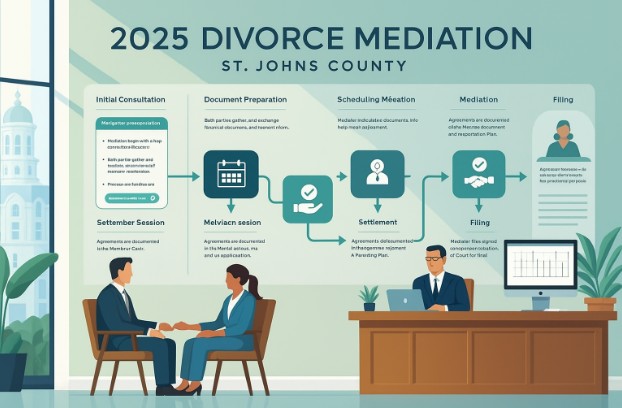
Divorce mediation in St. Johns County gives couples a peaceful way to end their marriage. A lot of people still feel unsure about the process and what it might cost.
Divorce mediation is a structured, confidential negotiation led by a neutral, Florida-certified mediator who helps both spouses reach fair agreements on property, custody, and support without a lengthy court battle.
Here’s the upside: Mediation usually saves time and money compared to fighting things out in court, especially if both people are willing to cooperate.
[cta_btn]
St. Johns County divorce mediation usually costs between $150 and $400 per hour for private mediators. Court-ordered mediation is around $120 per session, and you’re looking at 2-4 months from filing to final judgment.
This route lets couples retain control over decisions about property, custody, and support. A judge won’t be making these personal choices for them.
Knowing the steps, required forms, and real timelines helps people decide if mediation fits their situation.
St. Johns County offers family self-help services that make the process more accessible for those seeking less conflict and lower costs.
Key Takeaways
- Divorce mediation in St. Johns County costs $150-$400 per hour for private services and takes 2-4 months to complete.
- Couples keep control over custody, property, and support decisions—no judge decides for them.
- The county offers self-help resources and structured mediation to reduce conflict and legal bills.
What Is Divorce Mediation In St. Johns County, And How Does It Work In 2025?
Divorce mediation is a confidential, structured negotiation led by a neutral, Florida-certified mediator to resolve property, support, and parenting issues without a trial. In St. Johns County, most cases are mediated before any final hearing.
- When used: Court-ordered before trial or voluntary, any time.
- Outputs: Mediated Settlement Agreement (MSA) and Parenting Plan (if minor children).
- Benefits: Faster resolution, lower cost, spouses keep decision-making control
Mediation Vs. Litigation (Speed, Privacy, Control)
Divorce mediation in St. Johns County means a neutral third party helps couples settle disputes outside of court. The mediator won’t make decisions—they’re just there to help both sides reach an agreement.
Speed Differences:
- Mediation usually takes 2-6 sessions over a few weeks
- Litigation can drag on for 12-18 months or more
- Court schedules slow things down in traditional divorce cases
Privacy Benefits: Mediation sessions stay confidential. What you talk about doesn’t become public record. In contrast, litigation creates court documents that are publicly accessible.
Control Over Outcomes: In mediation, couples decide how to split property, arrange custody, and handle support. In court, a judge makes those calls based on limited testimony.
Mediation sessions can be in person or on Zoom, so couples can choose what works best for them. The focus is on creating solutions that fit both parties, not on picking a winner.
When Mediation Is Ordered Vs. Chosen Voluntarily: Where It Fits In The Local Case Flow
St. Johns County judges often require mediation before a contested divorce can go to trial. This comes after you file the initial paperwork, but before a final hearing is scheduled.
Court-Ordered Mediation: Judges usually order mediation when couples can’t agree on major issues such as custody or property. The court might order mediation 60-90 days after filing. Couples must try mediation in good faith before they can request a trial date.
Voluntary Mediation: Some couples choose mediation before filing divorce papers. This way, they work out agreements privately and file for an uncontested divorce. The Seventh Judicial Circuit offers low-cost mediation for families with combined incomes of $100,000 or less.
Local Case Timeline:
- Week 1-2: File initial divorce petition
- Week 4-8: Other spouse responds
- Week 12-16: Mediation usually happens (if ordered)
- Week 20-24: Final hearing (if mediation works out)
If mediation fails, you don’t lose your case. Couples move on to litigation if they can’t reach a mediation agreement.
Who Qualifies For Court Mediation Vs. Private Mediation In St. Johns County?

St. Johns County couples can use court mediation based on income and case complexity. Private mediation is available for those who want more flexibility and can afford it.
Eligibility depends on income, complexity, and court referral. Families earning under $100,000 qualify for the Seventh Judicial Circuit’s reduced-fee Family Mediation Program.
Court-ordered mediation follows specific procedures, while private mediation lets couples choose their own mediator and schedule.
Court Program Basics And Income Tiers: Indigent Status
Referrals to the Family Program come by Court Order in St. Johns County. Couples file a Motion for Order of Referral to the Family Mediation Program, and a judge decides whether to issue the Order of Referral.
The court uses a sliding fee scale based on income. Each person pays $60 per mediation session to the Clerk of Court.
Income-based qualifications:
- The court decides indigent status
- Lower fees for low-income families
- Standard court mediation fees for middle-income households
Court mediation works best for straightforward divorces. The process follows strict timelines set by the Seventh Judicial Circuit Court.
All fees are paid to the Clerk of Court at the time of scheduling. Always confirm current rates on the official Clerk’s site.
Private Mediator Use Cases (Complex Assets, Parenting Plan Nuance) And Local Options
Private mediation is the better fit for couples with complicated finances or detailed parenting plans. The main downside is cost, but it’s worth it for complex cases.
Private mediation is ideal for:
- High-asset divorces with business ownership
- Complex custody or parenting arrangements
- Cases needing flexible scheduling
- Couples wanting total privacy
St. Augustine and St. Johns County’s mediation center has conference rooms for up to 30 people. They offer certified circuit court mediators and family law specialists.
Private mediators let couples set their own schedule. You can work around jobs and family instead of waiting for the court calendar to open up.
These estimates are typical but vary depending on the docket’s speed. Always verify your assigned division’s scheduling through the St. Johns County Clerk’s Family Law Department.
Working with Peacemaker Mediation Group means less stress, fewer court appearances, and a mediated divorce that aligns with your goals. Contact us to start your journey.
[callus_btn]
Exact Step-By-Step Process For St. Johns County (From Consult To Final Judgment)
Your path is straightforward: consult → file & serve → mandatory disclosures → mediation → sign MSA/Parenting Plan → submit final papers → brief final hearing.
Private Mediation Vs. Court-Connected Mediation (How You Choose)
Private mediation means you pick your own certified mediator outside the court system. You schedule sessions when you want and move at your own pace. In St. Johns County, private mediators charge $150-$400 per hour.
Court-connected mediation happens through the court. The judge orders it before trial, and you get a list of approved mediators. Sessions must follow the court’s timeline.
Key Differences:
- Cost: Private costs more, but gives you flexibility
- Timeline: Private lets you set the schedule; court-connected is stricter
- Selection: Private means any certified mediator; court-connected gives you a list
Most couples try private mediation if they’re willing to work together. Court-connected mediation happens if couples can’t agree and need the court’s help.
Required Florida Residency & Basic Filing Facts (6-Month Rule)
One spouse must live in Florida for at least six months before filing. You’ll need proof—like a driver’s license, voter card, or utility bill.
You file in the county where either spouse lives. The person who files is the petitioner, and the other is the respondent.
Filing Requirements:
- Six months of residency proof
- Marriage certificate
- Financial affidavits
- Parenting plan (if you have kids)
Filing fees in St. Johns County average $400. There might be extra fees to serve papers to your spouse.
The court handles divorce, child support, and custody. Family law cases also include paternity, adoption, and modifications.
From First Call To Final Judgment — Who Does What

Initial Consultation (Week 1-2) The petitioner reaches out to a mediator or attorney. They talk through the situation, gather documents, and get a rundown of the process. Most consults take about 1-2 hours.
Filing Phase (Week 3-4) The petitioner files divorce papers with the St. Johns County Clerk of Court. They serve the papers to their spouse, who gets 20 days to respond. Both sides exchange financial info.
Mediation Sessions (Month 2-4). Couples meet for mediation to work out property, child, and support issues. Sessions last 2-4 hours each. Most people need 2-6 sessions overall.
Agreement Preparation (Months 4-5) The mediator drafts a settlement agreement based on the decisions. Both parties review and sign. Attorneys might look over everything before anyone signs.
Final Judgment (Month 5-6) The court reviews all the paperwork, including the settlement agreement and parenting plans. Final judgments must be submitted separately. A judge signs off, and the divorce becomes official.
Table — St. Johns County Divorce Mediation: Step-by-Step
How Much Does Divorce Mediation Cost In St. Johns County In 2025?
Most St. Johns County mediations fall between $3,500–$6,000 total, plus Clerk fees—lower for simple, uncontested cases; higher with complex assets or parenting issues.
2025 Cost Snapshot
The average cost of divorce mediation is between $3,500 and $6,000 for most St. Johns County couples in 2025. This covers three to five mediation sessions, document prep, and help with filing.
Many local mediators offer flat-rate packages for uncontested divorces. Usually, half the fee is due at the first session, with the rest due at the second.
Additional costs include:
- Court filing fees (set by St. Johns County)
- Financial advisor fees (if needed)
- Attorney consultation fees (optional)
The St. Johns County Clerk’s Office has increased filing fees because of state requirements. These are separate from the cost of mediation itself.
Couples can save up to $15,000 by choosing mediation over litigation. The exact savings really depend on how complicated things get and if there are kids or property to split.
| Scenario | Sessions (hrs) | Mediator fees |
| Uncontested, no kids | 6–8 | $1.5k–$2.4k |
| With minor children | 8–12 | $2k–$3.6k |
| Complex assets | 12–18 | $3k–$5.4k |
Peacemaker Mediation Group invites you to explore a cost-effective mediation strategy tailored for your St. Johns County divorce—let us build your roadmap together. Schedule an appointment.
[callus_btn]
What’s The Realistic Filing-To-Finish Timeline In St. Johns County?
Cooperative cases that settle at mediation often finalize within 8–16 weeks after filing; contested issues, appraisals, or evaluations can take 8–18 months.
Uncontested divorces in Florida move faster than contested cases that need several mediation sessions.
Fast-Path Scenario (Cooperative, Uncontested)
When both spouses agree on the big stuff, the process moves quickly. The required 20-day waiting period starts as soon as you file the petition.
Timeline Breakdown:
- Weeks 1-2: File petition and serve spouse
- Week 3: Waiting period begins
- Weeks 4-8: Handle financial disclosures and the parenting plan
- Weeks 8-12: Attend mediation (sometimes just one session)
- Weeks 12-16: Finalize the settlement agreement and file with the court
Most cooperative couples wrap things up in 4-6 months. Agreeing on child custody, property, and support ahead of time really speeds things along.
The mediator helps document everything properly. If there are no kids or major assets, it can go even faster.
Slower Scenario (Contested Issues; Additional Sessions Or Expert Input)
Complicated divorces take longer and often require input from other professionals. When spouses can’t agree, multiple mediation sessions are usually needed.
Extended Timeline Elements:
- Property appraisals: Add 2–4 weeks for real estate or business valuations
- Child custody evaluations: Can add 3–6 months
- Multiple mediation sessions: Each one adds 2–4 weeks
- Financial expert consultations: Add 1–2 months for tricky asset division
These cases often take 12–18 months to finish. If there’s domestic violence or substance abuse, it’ll probably take even longer.
Some couples end up needing 4–6 mediation sessions to reach an agreement. The court sometimes requires extra waiting periods between contested hearings.
Owning a business, having retirement accounts, or out-of-state property makes everything more complicated.
Is Mediation Worth It Versus Litigation In Northeast Florida?
Most St. Johns County couples save a lot of money and time with mediation. Still, some high-conflict situations really do need court intervention.
The decision depends on finances and safety, and every family’s situation is a little different.
Divorce litigation in Northeast Florida courts usually drags on for 8–18 months. Mediation, on the other hand, often wraps up in just 2–4 months.
Cost Breakdown:
- Mediation: $1,500–$5,000 total
- Litigation: $15,000–$35,000+ per spouse
The time difference is enormous, especially in St. Johns County, where courts stay busy and hearings get delayed. Mediation sessions fit your schedule, not the court’s.
Couples can meet in the evenings or on weekends, which helps if you’re juggling work and kids.
Florida couples are increasingly choosing mediation because it’s private. Court records go public, but mediation talks stay confidential.
Most people finish mediation feeling less stressed than those who go through litigation. They’re also more likely to maintain better co-parenting relationships afterward.
When Litigation May Still Be Necessary
Choose litigation when safety, discovery powers, or judicial decisions are required—e.g., domestic violence, hidden assets, severe non-cooperation, or complex valuation disputes.
High-conflict divorces need litigation if one spouse refuses to cooperate. Some people simply won’t negotiate in good faith.
Litigation becomes necessary when:
- Hidden assets require discovery powers
- Substance abuse impacts parenting
- Mental health issues block reasonable discussion
- Power imbalances make fair negotiation impossible
Complex business valuations sometimes need expert testimony in court. Mediation only really works when both spouses can access and understand the financial information.
In litigation, a judge makes the final decisions when couples just can’t agree. Sometimes, safety and fairness have to come first, even if it costs more.
Which Forms And Offices Matter For St. Johns County Divorces?
Divorce paperwork in St. Johns County uses state-approved forms and help from the local clerk’s office. The process depends on whether you pick simplified or regular dissolution.
Florida offers family law forms approved by the Florida Supreme Court for people who want to represent themselves. These are free and include the Petition for Dissolution of Marriage.
Simplified Dissolution works if you don’t have kids or property disputes. Both spouses must agree on everything and appear together at a court hearing.
Regular Dissolution applies when there are kids, property, or disagreements. This route needs more paperwork and several court steps.
Key forms include:
- Petition for Dissolution of Marriage
- Financial affidavits
- Parenting plans (if you have children)
- Property settlement agreements
Each form fits a different situation. Couples should consider their own circumstances before deciding which forms to fill out.
The St. Johns County Clerk of Court provides family self-help services for people handling divorce, custody, or protection orders on their own. This resource is surprisingly helpful.
The St. Johns County family law section handles all divorce matters, including dissolution of marriage, child support, and custody. Their office processes filings and keeps all the records.
How To Choose A Mediator In St. Johns County
Finding the right mediator means checking their credentials and making sure they’re a good fit for your needs. Watch out for things like unclear billing or missing written terms—they’re red flags.
Vetting Checklist (Certification, Niche Expertise, Scheduling, Remote Options)
Certification Requirements: All Florida mediators must have state certification. St. Johns Law Group has certified circuit court and family law mediators for different types of cases.
Check whether they’re explicitly certified in family mediation. That’s what you want for divorce.
Niche Expertise Some mediators focus on high-asset divorces, while others are better with custody disputes.
Ask what kinds of cases they usually handle. How many divorces do they mediate each year?
Scheduling Flexibility: Busy mediators might have a waitlist. If things are urgent, you’ll want someone who can fit you in quickly.
Ask if they’re available for follow-up sessions. Some divorces need several meetings to sort everything out.
Remote Options: Many mediators now offer video sessions. It saves everyone time and hassle.
Check if their tech setup is decent. Bad video or sound can make tough conversations even harder.
Red Flags (No Written Engagement Terms; Unclear Billing)
Missing Written Agreements: A professional mediator gives you a written engagement letter. This spells out the process, fees, and ground rules.
If someone wants to start without paperwork, that’s a problem. You don’t want confusion later on.
Unclear Billing Practice: Hourly rates should be clear from the start. Watch out for hidden fees, such as for room rentals or paperwork.
Ask for a fee schedule. The Seventh Judicial Circuit offers low-cost family mediation if your household income is under $100,000.
Pressure Tactics: Good mediators stay neutral. They shouldn’t push you toward any specific outcome.
If a mediator seems to take sides, that’s a big red flag. It can ruin the whole process.
Checklist — What To Bring To Mediation (And When To Take A Pause)
Preparation makes mediation smoother for both spouses. Gathering essential documents helps the mediator get a clear picture of their financial situation.
Financial Documents
- Bank statements (last 3 months)
- Tax returns (last 2 years)
- Pay stubs and employment records
- Credit card statements
- Investment account records
- Retirement account statements
Property and Asset Records
- Mortgage documents
- Property deeds
- Vehicle titles and loan information
- Insurance policies
- Business ownership papers
Child-Related Documents
- School records
- Medical records
- Childcare receipts
- Activity schedules
Before mediation starts, couples should figure out what they want versus what they need. It’s honestly easy to get sidetracked without that clarity.
When to Pause Mediation
Sometimes, you just need a break to get your head on straight. It’s smart to pause when:
- Emotions get too intense, and it’s tough to think straight
- Some new info pops up and needs a closer look
- You want to check in with your attorney
- Everyone’s just wiped out
Payment Preparation
Couples should discuss how they’ll split mediation costs before things kick off. Most mediators prefer payment arrangements to be settled in advance.
If you’re not sure what to bring, just ask the mediator for a document list tailored to your situation. It’ll help keep things moving and avoid wasting time.
Get a St. Johns County mediation plan, fee quote, and filing checklist tailored to your case. Book a free consultation and start your uncontested path today.
[contactus]
Frequently Asked Questions
What are the exact steps for a mediated divorce in St. Johns County (2025)?
File the petition with the St. Johns County Clerk, exchange mandatory financial disclosures, attend mediation (court-program or private), sign a mediated settlement agreement, then submit final paperwork and attend a short final hearing for the judge’s approval. Use the Clerk’s family law portal and the Seventh Circuit’s dissolution checklist to stay on track.
How much does divorce mediation cost locally in 2025?
Income-qualified cases referred to the Seventh Judicial Circuit Family Mediation Program pay set per-session fees (e.g., $120 per person at certain income tiers). In contrast, private mediators set their own hourly or flat rates.
How long does a mediated divorce typically take?
If both sides cooperate and settle at mediation, many Florida agreements are finalized within a few weeks to a few months; after signing, the court processes the final judgment. Timelines vary by case complexity and county scheduling.
Is mediation required before trial in St. Johns County?
Family cases are often referred to mediation by the court before a trial is set; parties may also choose private mediation at any time. The Seventh Judicial Circuit’s Family Mediation Program handles eligible referrals.
Which forms and disclosures are required before mediation/final hearing?
Each party must file a Financial Affidavit (Florida Family Law Forms 12.902(b) or 12.902(c)), exchange mandatory disclosure, and, when settling, file a Marital Settlement Agreement (Form 12.902(f)(3)); parenting class certificates are required when minor children are involved. Use the current Florida Courts forms directory.
Where do we file, and how do we schedule mediation?
File all dissolution documents with the St. Johns County Clerk of Court; the Clerk’s family law page provides process guidance. For court-referred sessions, scheduling is handled through the Seventh Circuit’s Family Mediation Program; parties can also hire a Florida Supreme Court–certified private mediator.
Is divorce mediation confidential, and can we choose our own mediator?
Mediation is a confidential, facilitated process to resolve issues without a public trial record; parties may select a private, Florida Supreme Court–certified mediator that fits their needs. The statewide mediator database can help you verify credentials.