
Florida divorce mediation becomes court-enforceable when both spouses sign a written Marital Settlement Agreement and file a complete packet with the Clerk of Court in the correct Florida county.
A Florida judge signs a Final Judgment only after the filed documents state clear, consistent terms for property, debts, parenting, and support.
If you want court-compliant drafting and assembly, start with divorce document preparation in Florida because document accuracy is the fastest path to a clean filing.
[cta_btn]
Key Takeaways
- Florida divorce mediation becomes court-enforceable only after both spouses sign a written Marital Settlement Agreement and file the required forms with the Clerk of Court in the correct Florida county.
- A Florida uncontested divorce packet usually includes a Petition, a signed Settlement Agreement, required financial disclosures when applicable, and Final Judgment forms, plus a Parenting Plan and time-sharing schedule when children are involved.
- Florida filings are most often delayed because of missing signatures, missing notarization, inconsistent names or dates across forms, or Parenting Plan language that conflicts with the time-sharing schedule.
- Court-compliant documents translate mediation terms into Florida Supreme Court-approved family law forms and statute-aligned clauses, so a judge can enter an enforceable Final Judgment.
What Court-Compliant Documents Mean In A Florida Mediated Divorce
Florida courts finalize divorce through filed documents, not verbal agreements. A mediation session produces settlement terms.
Court-compliant documents translate settlement terms into judge-ready language and Florida form structure, so you can file the first time correctly and avoid preventable clerk rejections.
If mediation is the right starting point for your case, review why choose mediation for the practical differences between negotiated settlement structures and litigated outcomes.
Florida court compliance usually includes these requirements:
- Florida Supreme Court-approved Family Law Forms match the case type and case posture, as outlined in the form guidance on the Florida Courts Family Law Forms page.
- Party names, dates, and core case facts match across every document in the packet.
- Signatures and notarizations appear where the form instructions require execution formalities, using the completion rules in the Florida Courts Family Law Forms instructions.
- Parenting terms support the entry of enforceable orders under Florida Statute 61.13.
- Child support terms align with guideline logic under Florida Statute 61.30.
- Spousal support terms use enforceable definitions consistent with Florida Statute 61.08.
The Filing Flow. How A Mediated Agreement Becomes A Finalized Divorce
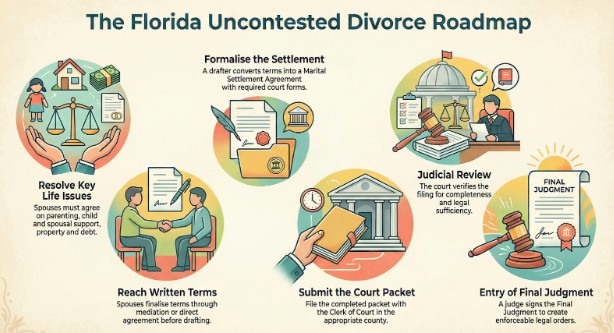
A Florida uncontested divorce follows a sequence. Spouses agree first. Spouses document next. Spouses file next. A judge finalizes last.
A typical sequence looks like this:
- Spouses identify issues that require written resolution, including parenting, child support, spousal support, property division, and debt allocation.
- Spouses reach written terms through mediation or direct agreement.
- A drafter converts the terms into a court-usable Marital Settlement Agreement, along with the required supporting forms listed on the Florida Courts Family Law Forms.
- Spouses file the packet with the Clerk of Court in the correct Florida county.
- The court reviews the filing for completeness and legal sufficiency based on the filed forms and required attachments.
- A judge signs the Final Judgment when the packet supports entry of enforceable orders.
If you want the service pathway that combines settlement structure and paperwork coordination, start with an uncontested divorce, as the uncontested process links agreement terms to filing outcomes.
Uncontested Divorce Documents In Florida. The Core Packet
A Florida uncontested divorce packet is a coordinated set of documents. A court-ready packet resolves every required issue and repeats the same facts consistently across every form.
Most uncontested packets include:
- A Petition and required cover sheets for the county, using the correct form group from Florida Courts Family Law Forms
- A written Marital Settlement Agreement signed by both spouses
- Financial disclosures when the procedure requires disclosure for the case posture
- A Parenting Plan and time-sharing documents when parents share minor children under Florida Statute 61.13
- Final Judgment forms and supporting affidavits that allow entry of final orders
[callus_btn]
Parenting Plan Documents. The Paperwork That Protects Time-Sharing Terms
A Florida Parenting Plan is a court-ordered document required when parents share minor children.
A Parenting Plan reduces conflict when it specifies enforceable logistics rather than general intentions, using the parenting and time-sharing framework in Florida Statute 61.13.
Build your Parenting Plan using:
- Florida parenting plan for required sections and court-usable language
- St. Johns County time-sharing schedules for schedule structures that reduce ambiguity
Parenting Plan Elements That Courts Can Enforce
A Parenting Plan becomes enforceable when it answers operational questions with dates, times, and definitions.
- Weekday and weekend time-sharing with exact exchange times
- Holiday schedule with pickup and drop-off details
- Summer schedule with travel notice rules
- Decision-making responsibilities by category, including education and healthcare
- Parent communication methods and response expectations
- Transportation rules, including exchange locations and late policies
Child Support Calculations. How To Keep Support Terms Consistent With Court Expectations
Florida child support orders rely on the guideline logic set forth in Florida Statute 61.30.
A filing stalls when child support numbers conflict with income assumptions, parenting-time assumptions, or expense categories required by the guideline framework.
If you want a settlement pathway that keeps parenting and support terms consistent across the agreement and the filing packet, start with an uncontested divorce, as it reduces contradictions.
Alimony Terms. How To Document Spousal Support So The Agreement Reads Like A Court Order
Florida spousal support clauses become enforceable when the clause defines the amount, payment frequency, start date, end conditions, and enforcement language. Florida law governs alimony under Florida Statute 61.08.
For a structured support approach, use:
- divorce mediator process for how mediation addresses support terms
- Contested divorce to understand how vague support language pushes cases into litigation
- An uncontested divorce for a settlement structure that courts can approve
Court-Connected Vs Private Mediation. Why The Paperwork Experience Differs
Florida court-connected mediation can resolve disputes, but court-connected mediation usually does not include document drafting or packet coordination.
Private mediation more often includes structured agreement language, revisions, and document alignment that support filing readiness.
If you are evaluating the best route in your county, use court-connected vs. private mediation in St. Johns County, as the comparison clarifies trade-offs in speed, cost, and document support.
[callus_btn]
Cost Planning. Filing Fees Are Not The Only Numbers That Matter
Florida divorce costs usually come from five buckets, not one bill. A realistic plan includes mediation time, document drafting and revisions, court filing and admin fees, service of process, and implementation costs for property or retirement transfers.
Clear budgeting early prevents delays caused by missing documents or underestimating post-settlement steps.
Cost Buckets To Expect
- Mediation Time: Increases with parenting disputes, high-conflict communication, or unclear finances.
- Drafting and Revisions: Increases when Parenting Plan details, support terms, or asset language require multiple edits.
Court Filing And Admin: Filing fees plus copies, notarization, and certified documents when required. - Service Costs: Adds cost when a spouse avoids service or cannot be located.
- Implementation Costs: Deeds and recording for real property, and QDRO or plan processing steps for retirement accounts.
Fast Planning Rule
Collect pay stubs, tax returns, account statements, and a draft time-sharing schedule before you set a budget, so the settlement terms match the paperwork and avoid expensive rework.
The Quality-Control Checklist That Prevents Clerk Rejections
Clerks and judges reject packets for predictable reasons. A packet becomes court-ready when every document passes a consistency check across names, dates, definitions, signatures, and attachments.
The Most Common Rejection Triggers
- Signature blocks are missing, inconsistent, or not dated
- Notarization is missing where required
- Settlement terms conflicting with Parenting Plan terms
- Time-sharing schedule language conflicts with Parenting Plan language
- Support terms missing definitions, dates, or payment structure
- Attachments are missing, or financial disclosure fieldsare incomplete
A Practical Pre-Filing Quality Check
- Confirm the venue and county match the case facts
- Confirm names, dates, and addresses match across the entire packet
- Confirm every signature line and notary block is completed correctly
- Confirm that the Parenting Plan and time-sharing schedule match exactly
- Confirm support terms remain specific and internally consistent
- Confirm the packet includes every required attachment before filing
When To Use Document Preparation Vs Full Mediation
Document preparation fits spouses who already agree and need accurate drafting and assembly. Mediation fits spouses who need structure to resolve parenting, support, or financial terms before drafting.
If you are unsure which service level fits your situation, read “When to Hire a Mediator for Divorce,” because the decision-making map aligns with common case patterns.
If you want your agreement translated into court-compliant paperwork, start with divorce document preparation in Florida, and we will focus on accuracy, consistency, and filing readiness.
If you want a full settlement pathway that leads to filing, start with an uncontested divorce and then reach out to us through the contact page.
[contactus]
Frequently Asked Questions
What documents do I need to file an uncontested divorce in Florida?
A Florida uncontested divorce typically requires a Petition for Dissolution, the Florida Supreme Court-approved Family Law Forms, a signed Marital Settlement Agreement, and Final Judgment paperwork. Cases involving children also require a Parenting Plan and child support documents.
Where do I file divorce papers in Florida, and what county should I use?
File Florida divorce documents with the Clerk of Court in the county with proper venue, typically where a spouse resides. County clerks provide dissolution packets and filing instructions, including what to submit and how to pay fees.
Is a mediated settlement agreement legally binding in Florida, or does a judge have to approve it?
A Florida mediated settlement agreement can be binding once signed, but the divorce becomes final only when the court enters a Final Judgment. File the agreement and required forms so a judge can approve and incorporate the terms.
Do I need a Florida Parenting Plan and time-sharing schedule to file a divorce with children?
Florida courts require a Parenting Plan in cases involving minor children. A time-sharing schedule should specify overnights, exchanges, holidays, and transportation rules. Clear Parenting Plan terms reduce disputes and support enforceable court orders.
Do I have to file a financial affidavit in a Florida divorce?
Florida cases that require a financial affidavit use the Florida Family Law Financial Affidavit forms. The short form applies under stated-income thresholds, with exceptions for simplified dissolution and for some settled cases without support issues.
What is the Florida divorce filing fee, and what other filing costs should I expect?
Many Florida self-help packets list a $409 clerk filing fee, but fees can vary by county and case type. Budget for copies, notarization, service of process, and certified documents if a bank or agency requires proof.
How long does an uncontested divorce take in Florida once the paperwork is filed?
The timeline depends on county procedures and the completeness of the documents. Some clerk resources describe simplified divorce timelines of about 30 days to a hearing date, while other cases take longer if documents are incomplete or contested issues arise.
What are the most common reasons a Florida divorce filing gets rejected or delayed?
Florida divorce packets often get delayed due to incomplete forms, missing signatures, missing notarization, inconsistent names or dates, and missing required attachments. Using the correct Florida Supreme Court-approved forms reduces avoidable clerk rejections.