
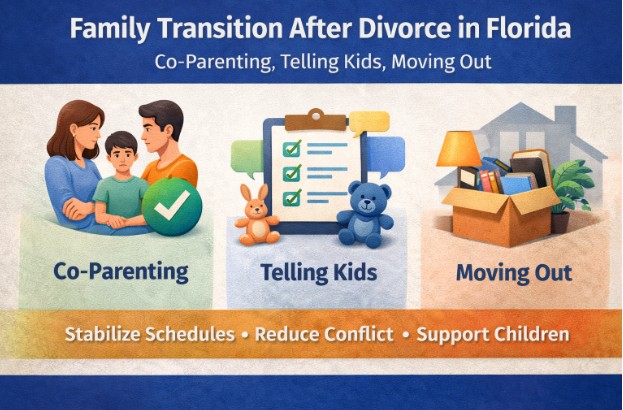
A Florida family transition after divorce succeeds when parents reduce children’s exposure to conflict, stabilize school-night routines, and document time-sharing logistics in a written Parenting Plan.
Parents improve outcomes by using clear communication rules, age-appropriate divorce scripts, and move-out planning that protects schedules, finances, and relocation compliance.
Use this guide to stabilize school nights, reduce schedule disputes, and keep children out of adult conflict.
Parents who want a court-usable structure can start by aligning family routines with a Florida Parenting Plan.
[cta_btn]
Key Takeaways
- A Florida family transition succeeds when parents reduce exposure to conflict, preserve routines, and use written Parenting Plan language that defines exchanges and schedules.
- Children adjust better when parents repeat reassurance messages, maintain routines, and avoid blame narratives, consistent with AAP child guidance.
- Time-sharing disputes drop when parents define holidays, summer weeks, transportation rules, and late policies with specific terms rather than vague promises.
- Moving out works best when parents plan housing, school logistics, records, and budget before separation, especially when relocation rules can apply.
What A Family Transition Means After Divorce In Florida
A family transition is the operational shift from one household system to two household systems.
A family transition includes where children sleep on school nights, how parents share transportation, how parents manage school communication, and how parents pay recurring child expenses.
A family transition also includes emotional processing. Children experience divorce through daily routines, not legal filings.
Children notice tone, predictability, and patterns of parental conflict more than legal vocabulary.
Florida law treats parenting structure as enforceable language. Florida courts evaluate parenting arrangements through written parenting terms and time-sharing schedules governed by Florida’s parenting statute.
A primary reference point for parenting and time-sharing orders is Florida Statute 61.13.
The Three Outcomes That Predict A Stable Transition
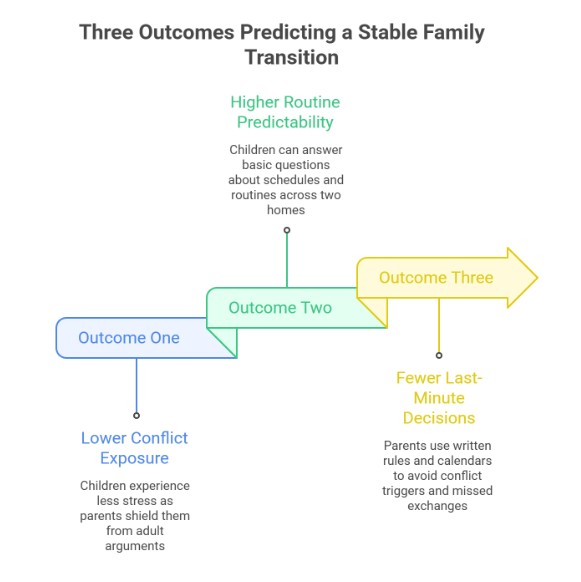
A stable family transition produces three measurable outcomes. A stable family transition reduces exposure to conflict.
A stable family transition increases routine predictability. A stable family transition reduces decision churn.
Outcome One. Lower Conflict Exposure For Children
Children experience stress when they witness parent arguments, threats, or loyalty tests. Parents reduce harm by keeping adult conflict out of child-facing spaces, including car rides, school pickup lines, and bedtime routines.
Outcome Two. Higher Routine Predictability Across Two Homes
Predictability means children can answer basic questions. Children can name which parent handles school pickup.
Children can name where they sleep on school nights. Children can name exchange locations and exchange times.
Outcome Three. Fewer Last Minute Decisions
Last-minute decisions create conflict triggers. Last-minute decisions create accusatory texts.
Last-minute decisions create missed exchanges. Parents prevent last-minute decisions by using written rules and calendar-driven systems.
[callus_btn]
Co-Parenting That Reduces Conflict And Protects Kids
Co-parenting success comes from systems, not slogans. A co-parenting system reduces misunderstanding.
A co-parenting system reduces negotiation frequency. A co-parenting system reduces message volume.
A Co-Parenting Operating System Parents Can Follow
Parents create stability by standardizing communication and schedules. Parents reduce conflict by limiting the number of topics per message and the time window for messages.
| System Component | Rule | So You Can |
| Single Calendar | Parents use one shared calendar for exchanges, holidays, and school events | Reduce schedule disputes and reduce missed exchanges |
| Single Channel | Parents use one channel for logistics messages, not multiple apps | Reduce lost messages and reduce selective screenshot fights |
| Single Topic | Parents keep each message limited to one topic | Reduce escalation and reduce argument stacking |
| Response Window | Parents respond within a defined timeframe for non-emergency items | Reduce anxiety and reduce follow-up spam |
| Documentation Habit | Parents attach receipts and confirm dates for expenses | Reduce reimbursement disputes and reduce accusations |
The American Psychological Association describes common child adjustment issues during divorce and custody transitions, including the value of a predictable caregiving structure.
Communication Rules That Stop Repeat Arguments
Parents protect children by separating logistics from emotion. Parents keep logistics messages short. Parents place emotion processing in therapy, support groups, or private conversations.
Rules That Reduce Escalation
- Parents use neutral language focused on time, place, and cost.
- Parents avoid blame language, including “always” and “never.”
- Parents avoid courtroom language in text messages.
- Parents avoid child messenger roles.
- Parents confirm decisions in writing after verbal conversations.
Copy And Paste Message Templates
These templates create clarity. These templates reduce tone ambiguity.
Schedule Swap Request
“I am requesting a swap for Tuesday pickup at 5:00 PM. I will trade on Thursday, pickup at 5:00 PM. Please reply by 6:00 PM today.”
Exchange Logistics Confirmation
“Exchange will occur at the school front entrance at 3:00 PM. The exchange plan remains the same for next week.”
Expense Reimbursement Request
“I paid the child’s school fee of $125 on February 12, 2026. Please reimburse $62.50 by February 20, 2026. Receipt attached.”
Telling Kids About Divorce With Age-Appropriate Language
Children need reassurance and predictability. Children do not need adult blame narratives. Children benefit from repeated reminders that divorce is not a child’s fault.
The American Academy of Pediatrics emphasizes the use of reassuring, stable language for children during divorce transitions.
The Three Messages Children Need Most
Parents protect children by consistently repeating three messages.
- “Both parents love you.”
- “The divorce is not your fault.”
- “Your schedule will stay consistent, and adults will handle adult problems.”
Age-Based Scripts Table
Use these scripts as a starting point. Adjust the script to the child’s personality and questions.
| Age Group | Goal | Script Parents Can Use |
| Ages 3 To 6 | Safety and routine | “Mom and Dad will live in two homes. You will be safe in both homes. The divorce is not your fault.” |
| Ages 7 To 12 | Predictability without blame | “We are changing how our family lives. You will know the school day and weekend schedules. You can talk to either parent about feelings.” |
| Teens | Respect and boundaries | “We will answer questions honestly without blaming. School and activities stay protected. The schedule will stay consistent.” |
Conversation Rules That Reduce Harm
Parents improve outcomes by managing the setting and the timing.
- Parents tell children together when safe and practical.
- Parents should tell children about major changes before, not after.
- Parents avoid legal jargon, including “petition” and “motion.”
- Parents avoid sharing details of adult financial conflicts.
- Parents invite questions and answer questions without sarcasm.
Peacemaker Mediation Group can map a structured transition plan that reduces message conflict and reduces schedule confusion, then support court-ready drafting when parents are ready. Contact us.
[callus_btn]
Time-Sharing Structure That Stops Repeat Disputes
A time-sharing schedule fails when parents rely on flexible promises. A time-sharing schedule succeeds when parents define edge cases with exact rules.
Parents benefit from tested scheduling frameworks that align with school calendars, work schedules, and travel realities.
Parents can review schedule models and common patterns on St. Johns County time-sharing schedules.
Time-Sharing Terms That Need Exact Definitions
Parents reduce conflict by defining the terms that trigger repeat fights.
- Exchange time and exchange location for every exchange
- School-day versus non-school-day definitions
- Holiday start time and holiday end time
- Summer week allocation and travel notice rules
- Make-up time rules for missed time-sharing
- Transportation responsibility and late arrival policy
Parenting Plan Precision Table
Use this table as a drafting checklist when parents translate real-life routines into enforceable language.
| Parenting Category | Decision Parents Must Make | Risk When Parents Stay Vague |
| Exchanges | Time, place, and late policy | Missed exchanges and repeated arguments |
| Holidays | Exact start and end windows | Overlaps and double-booking |
| School | Pickup responsibility and communication rules | School confusion and mixed messages |
| Travel | Notice window and itinerary requirements | Surprise travel disputes |
| Communication | Approved channel and response window | Message floods and tone escalation |
Moving Out Without Creating A Parenting Or Financial Crisis
Moving out changes routines and finances immediately. Moving out also changes leverage.
Parents maintain stability by planning the move as a project, with records, timelines, and child logistics.
Move-Out Checklist Parents Can Use
Parents reduce conflict by preparing documentation and by preparing child routines.
- Identify school-night sleep locations before the first move-out night
- Define school pickup responsibility and after-school supervision
- Photograph major household items and list high-value property
- Copy key records, including tax returns, insurance policies, and account statements
- Create a two-household budget that covers housing, childcare, and transportation
Florida relocation rules can apply when a move changes the child’s principal residence or changes travel distance in a way that affects time-sharing. Florida’s relocation statute is Florida Statute 61.13001.
The Move-Out Budget Categories That Matter
Parents avoid financial shocks by mapping recurring categories before separation.
- Housing and utilities for two residences
- Childcare and extracurricular schedules
- Transportation and school-related mileage
- Health insurance premiums and out-of-pocket costs
- School fees, supplies, and activity fees
A Practical Conflict Ladder Parents Can Recognize Early
Conflict escalates in predictable stages. Parents reduce damage by responding early and by using structured rules.
| Stage | What Parents Notice | What Parents Do Next |
| Tension | Delayed replies and short messages | Use templates and stick to response windows |
| Arguments | Blame language and repeated schedule disputes | Use single-topic messages and calendar options |
| Retaliation | Withholding information or canceling exchanges | Use exact written rules and document deviations |
| Breakdown | No agreement and repeated threats | Use structured negotiation and formal drafting |
The Centers for Disease Control and Prevention summarizes how safe, stable, nurturing relationships protect children from the adverse effects of stressors.
Keeping Children Out Of Adult Conflict
Children do not need messenger roles. Children do not need financial updates. Children need permission to love both parents.
Child Protection Rules Parents Can Follow
- Parents do not discuss legal strategy in front of children
- Parents do not ask children to report on the other parent
- Parents do not use children to deliver money requests or schedule demands
- Parents do not label a parent as “good” or “bad” to a child
- Parents share schedule information with schools and caregivers, not conflict narratives
School And Caregiver Coordination
Parents experience less disruption when schools provide consistent information.
- Provide schools with the time-sharing schedule and emergency contacts
- Provide caregivers with pickup authority and pickup rules
- Keep school communication focused on academics and health, not the divorce dispute
Common Family Transition Mistakes That Delay Settlement
Mistakes create repeated renegotiation. Repeated renegotiation creates ongoing conflict. Ongoing conflict reduces child stability.
High-Frequency Mistakes
- Parenting schedules without exact exchange terms
- Holiday language that overlaps or conflicts
- Flexible promises without a tie-break rule
- Expense terms without reimbursement deadlines and proof rules
- Communication rules that allow 20-message arguments
Parents improve outcomes when they use a defined mediation sequence and a drafting sequence. The step-by-step workflow lives in the divorce mediator process.
When Professional Support Helps Most
Support works best before a crisis. Support works best when parents treat support as prevention.
Professional support often helps when:
- A child shows persistent sleep disruption or school refusal
- Parents cannot exchange without arguments
- Parents cannot agree on holidays, travel, or activity costs
- One parent repeatedly changes terms after the agreement
Peacemaker Mediation Group helps parents translate real-life routines into enforceable parenting terms and written schedules, so children get stability across two homes. Schedule an appointment.
[contactus]
Frequently Asked Questions
What Is A Family Transition After Divorce In Florida
A family transition is the shift from one household routine to two. A family transition includes time-sharing logistics, parent communication rules, child expense workflows, and move-out planning that protects school-night stability.
How Do Parents Co-Parent Without Constant Arguments
Parents reduce conflict by using a single shared calendar, a single communication channel, and one-topic messages. Written schedules, defined response windows, and documented expense requests reduce misunderstandings and escalations.
What Should Parents Say When Telling Kids About Divorce
Parents should say that both parents love the child, that the divorce is not the child’s fault, and that the child’s routine will remain stable. Parents should avoid blame language and avoid adult financial details during the conversation.
What Parenting Plan Details Prevent Repeat Time-Sharing Disputes
A Parenting Plan prevents disputes when it defines exchange times, exchange locations, holidays, summer weeks, transportation responsibility, and late policies with exact language. Exact definitions reduce interpretation fights.
How Should Parents Handle Holidays And School Breaks After Separation
Parents should use written start and end times for each holiday, define pickup and drop-off locations, and define travel notice rules. A calendar-based schedule prevents double-booking and prevents last-minute negotiation.
What Should A Parent Do Before Moving Out During A Florida Divorce
A parent should plan school-night housing, document household property, copy financial records, and build a two-household budget. A parent should avoid relocation surprises that change time-sharing logistics without notice.
How Do Parents Keep Children Out Of Adult Conflict
Parents protect children by avoiding messenger roles, avoiding loyalty tests, and keeping legal discussions out of children’s reach. Parents should communicate directly with the other parent and keep school communication focused on logistics.
When Should Parents Get Outside Support During A Divorce Transition
Parents should seek support when a child shows persistent school refusal, sleep disruption, or behavior changes, or when exchanges trigger repeated conflict. Early support stabilizes routines and reduces escalation.