
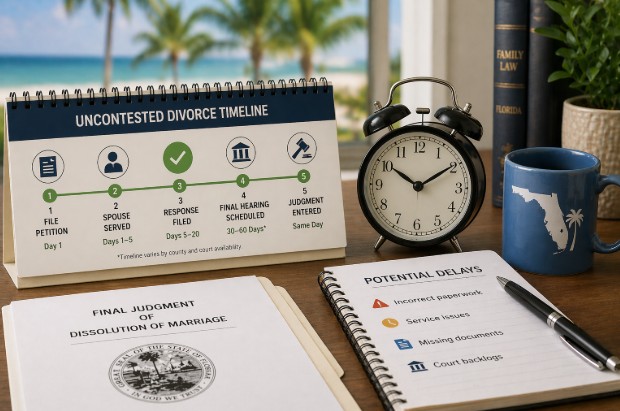
An uncontested divorce in Florida takes 4 to 12 weeks from filing to final judgment when both spouses agree on all issues, paperwork is complete, and the court’s calendar is open.
Florida Statutes § 61.19 sets a mandatory 20-day minimum waiting period from the filing date before a judge can sign the Final Judgment of Dissolution — so no uncontested divorce, regardless of how prepared both spouses are, can be finalized in fewer than 20 days.
Most cases last between six and ten weeks.
[cta_btn]
Peacemaker Mediation Group helps Florida couples reach full agreement before filing, so their uncontested divorce moves through the court process without preventable delays.
Key Takeaways
- Florida Statutes § 61.19 sets a mandatory 20-day waiting period from filing before a judge can enter the Final Judgment of Dissolution — this floor applies to every uncontested case without exception.
- A simplified dissolution — for couples with no minor children, no alimony, and fully resolved property — completes in 30 to 45 days under ideal conditions.
- A standard uncontested dissolution typically takes 6 to 12 weeks; cases with minor children take longer due to the parenting course requirement under Fla. Stat. § 61.21
- Court scheduling backlogs, incomplete financial disclosures, and delayed service of process are the three most common causes of extended timelines in otherwise uncontested case.s
What Is the Fastest an Uncontested Divorce Can Be Finalized in Florida?
The fastest an uncontested divorce finalizes in Florida is 30 days — the absolute minimum set by Fla. Stat. § 61.19, which prohibits any judge from entering a Final Judgment of Dissolution until at least 20 days after the petition is filed.
Florida courts grant waivers of the waiting period only in rare circumstances — military deployment to a combat zone or a time-sensitive real estate transaction are the most commonly cited examples. Florida courts do not routinely waive the 20-day period, and couples should not plan their timeline around receiving one.
The simplified dissolution — available only to couples with no minor children, no pregnancy, no alimony request, and a fully resolved property agreement — comes closest to that minimum.
Both spouses file the joint petition together in person at the Circuit Court clerk’s office, and most counties schedule the final hearing within two to three weeks after the mandatory period expires.
From filing to final judgment, a simplified dissolution typically completes in 30 to 45 days when all requirements are met on day one.
Standard uncontested dissolution cases — those involving children, property division terms, or alimony — add procedural steps that extend the timeline past 30 days even when both spouses cooperate fully.
Service of process, financial affidavit exchange, and court scheduling each consume calendar time that cannot be compressed below certain practical minimums.
What Is the Realistic Timeline for a Standard Uncontested Divorce in Florida?
A standard uncontested divorce in Florida realistically takes 6 to 12 weeks from filing to final judgment when both spouses cooperate, all forms are completed correctly, and the local court calendar has available hearing dates.
Cases with minor children routinely add two to four additional weeks due to the mandatory parenting course requirement under Fla. Stat. § 61.21.
The procedural sequence that determines the timeline runs as follows. The petitioner files the petition and pays the $408–$409 filing fee as verified in 2026; the 20-day statutory clock begins on that date.
The respondent receives service and has 20 days to file an Answer and Waiver — the two 20-day windows frequently overlap but do not always run simultaneously.
Once the respondent answers, both spouses exchange Financial Affidavits under Florida Family Law Rules of Procedure Rule 12.285, which requires disclosure within 45 days of service. After disclosures are complete, the case is eligible for a final hearing, which the court schedules based on available calendar dates.
| Divorce Path | Typical Timeline | Key Requirement |
| Simplified dissolution | 30–45 days | No children; no alimony; both appear together at filing |
| Standard uncontested — no children | 6–10 weeks | Financial affidavits; service of process; final hearing |
| Standard uncontested — with children | 8–14 weeks | Parenting course certificates are required before the final hearing |
| Mediation-assisted uncontested | 6–10 weeks | Agreement reached before filing; paperwork complete at filing |
Peacemaker Mediation Group produces all required Florida court documents and files the completed packet with the St. Johns County Circuit Court clerk, so couples who use the firm’s divorce mediation service enter the court process with every form already completed — eliminating the document preparation phase as a timeline variable.
[callus_btn]
How Does the Parenting Course Requirement Affect the Timeline?

Florida requires both parents to complete a court-approved Parent Education and Family Stabilization Course before a judge will enter the Final Judgment of Dissolution in any case involving minor children, under Fla. Stat. § 61.21.
The petitioner must complete the course within 45 days of filing; the respondent must complete the course within 45 days of being served. Each parent files the completion certificate with the court, and the final hearing cannot be scheduled until both certificates are on record.
The course is a minimum of four hours. Florida Department of Children and Families-approved online courses are typically under $40 and allow parents to complete the requirement at their own pace.
The timeline risk is not the course itself — four hours online can be done in a single evening — but rather the failure to complete and file the certificate before trying to schedule the final hearing.
Couples who treat the parenting course as a post-filing task routinely discover the court will not schedule the hearing until both certificates are received, adding two to four weeks to the process.
Completing the parenting course before the petition is filed, or in the same week as filing, is the most reliable way to prevent certificate-related delays from pushing the timeline past twelve weeks.
The Florida parenting plan requirements and the parenting course are both pre-hearing obligations — not steps to address after the hearing is scheduled.
What Delays an Uncontested Florida Divorce Most Often?
Most delays in an otherwise uncontested Florida divorce trace to four specific procedural breakdowns, each of which adds weeks rather than days to the timeline. Understanding where delays originate gives couples the information to prevent them before filing.
Delayed or failed service of process is the first and most common delay source. The petitioner must serve the respondent with the petition and summons after filing; service triggers the 20-day response window and the 45-day financial disclosure deadline.
A respondent who is difficult to locate or who avoids service extends the timeline by weeks.
In a simplified dissolution, both spouses file jointly, and service is not required, removing this risk entirely. In standard uncontested cases, the respondent may waive formal service by signing a waiver of service at the same time as the settlement agreement, thereby restoring predictability to the timeline.
Incomplete or late financial affidavits are the second major delay source. Florida Family Law Rules of Procedure Rule 12.285 requires both spouses to exchange Financial Affidavits — Form 12.902(b) for annual incomes under $50,000, Form 12.902(c) for incomes at or above $50,000 — within 45 days of service.
Missing a supporting document, using an outdated form, or failing to include a required financial schedule results in the clerk rejecting the filing and restarting the disclosure process.
Both spouses should gather financial records — three years of tax returns, three months of pay stubs, recent bank statements, and all property and debt records — before filing, not after.
Couples who want a full picture of the financial timeline and document costs can use the Florida divorce cost calculator before beginning the process.
Court calendar backlogs are the third delay source and the one that couples control least. High-volume Florida circuits, including Miami-Dade, Broward, and Hillsborough, run significantly longer scheduling queues than smaller circuits.
St. Johns County and neighboring First Coast circuits are smaller-volume circuits, which typically translates to shorter scheduling queues than high-volume circuits like Miami-Dade, Broward, and Hillsborough. Contacting the judicial assistant shortly after filing to confirm the court’s current scheduling window gives couples an accurate timeline before they start counting days.
Agreement breakdown after filing is the fourth source of delay — and the one that converts the timeline from weeks to months.
A couple who file as uncontested but cannot hold their agreement through the process sees the case reclassified as contested.
Contested reclassification triggers attorney involvement, discovery, and a timeline that can extend from weeks to months. Peacemaker Mediation Group’s amicable divorce mediation process is specifically designed to produce a signed, durable Marital Settlement Agreement before filing — so both spouses enter the court process with an agreement already in place, not a fragile verbal understanding.
[callus_btn]
How Does Mediation Before Filing Affect the Timeline?
Couples who complete mediation before filing for divorce consistently reach the final hearing faster than couples who file first and attempt to finalize agreements afterward. Mediation before filing produces a signed Marital Settlement Agreement — including property division, debt allocation, time-sharing schedule, child support calculation, and alimony terms — that both spouses have already reviewed and approved.
The petitioner files the petition and the completed settlement agreement simultaneously on day one.
Filing with a completed Marital Settlement Agreement in hand removes the document negotiation phase from the court timeline.
Florida courts that receive a complete, signed filing move directly to scheduling the final hearing after the mandatory waiting period expires. No correction requests, no incomplete disclosure letters, no adjournments to negotiate a remaining term.
Couples who file without a finalized agreement — even in nominally uncontested cases — frequently discover that finalizing remaining terms while the case is pending adds weeks.
A single unresolved clause in the Marital Settlement Agreement requires both spouses to re-sign, re-notarize, and refile an amended document, which resets the filing review process. Couples who resolve every term in mediation before filing eliminate this scenario.
Understanding why to choose mediation before filing is not only a cost question — it is a timeline question.
The divorce mediation preparation guide outlines exactly which financial documents both spouses should prepare for the mediation session so the agreement produced is complete and court-ready on the same day it is signed.
What Happens at the Final Hearing in an Uncontested Florida Divorce?
The final hearing in an uncontested Florida divorce is a brief, procedural court appearance — not an adversarial proceeding. Uncontested final hearings typically last 10 to 20 minutes.
The judge reviews the Marital Settlement Agreement and all supporting filings, asks each spouse a few questions to confirm that the agreement was entered into voluntarily and that the marriage is irretrievably broken under Fla. Stat. § 61.052, and then signs the Final Judgment of Dissolution of Marriage.
Both spouses typically attend the final hearing in standard uncontested cases. In simplified dissolution cases, both spouses must appear together.
Some Florida counties process uncontested divorces by written submission — without requiring a hearing — when all required documents are complete, and both spouses have waived appearance. Couples should confirm their county’s current procedure with the clerk’s office before the hearing date.
The signed Final Judgment becomes the legally operative document ending the marriage. Both spouses receive certified copies of the Final Judgment.
The Marital Settlement Agreement is incorporated into the Final Judgment and becomes enforceable as a court order — meaning both spouses can seek enforcement through the same court if any term is later violated.
The divorce mediation process at Peacemaker Mediation Group includes filing documents with the clerk, so couples are not left to navigate the hearing scheduling process on their own.
How Can Couples Keep Their Uncontested Florida Divorce on Schedule?

Florida couples who want to finalize an uncontested divorce in the shortest realistic window — six to eight weeks for cases without children, eight to twelve weeks for cases with children — take five specific actions before and immediately after filing.
Complete Mediation Before Filing
Completing mediation before filing produces a signed, court-ready Marital Settlement Agreement on day one, so no terms remain open when the petition is submitted.
Gather All Financial Documents Before Filing
Gathering all financial documents — three years of tax returns, current pay stubs, bank statements, retirement account balances, property deeds, and debt records — before filing prevents the disclosure exchange from becoming a delay source.
Complete the Parenting Course in the Week of Filing
Completing the parenting course in the week of filing, for couples with minor children, ensures the completion certificate is ready to file before the court is even asked to schedule a hearing.
Review All Forms on the Day of Filing
Reviewing all forms against the current versions at Florida Courts family law forms on the day of filing — not weeks before — prevents clerk rejection of superseded form versions.
Contact the Judicial Assistant After Filing
Contacting the judicial assistant in the week after filing to confirm the court’s current hearing scheduling window sets accurate timeline expectations and surfaces any local procedural requirements the couple should address early.
Couples who follow this sequence remove the four most common delay sources from their timeline. Peacemaker Mediation Group’s flat-fee service covers mediation, document preparation, and divorce document filing with the clerk — addressing the four controllable timeline variables in a single engagement.
[contactus]
Frequently Asked Questions
How long does an uncontested divorce take in Florida?
A standard uncontested divorce in Florida takes 6 to 12 weeks from filing to final judgment in most cases. Florida Statutes § 61.19 sets a mandatory 20-day minimum from the filing date before a judge can sign the Final Judgment. Cases with children typically take 8 to 14 weeks due to the parenting course requirement.
What is the mandatory waiting period for divorce in Florida?
Florida Statutes § 61.19 prohibits a judge from entering a Final Judgment of Dissolution until at least 20 days after the petition is filed. Courts waive this period only when an earlier judgment is necessary to prevent injustice — a standard rarely met. The 20-day period applies to every Florida divorce, contested or uncontested, without exception.
Can a Florida divorce be finalized in 30 days?
A Florida divorce can be finalized in 30 to 45 days only through the simplified dissolution process — available exclusively to couples with no minor children, no alimony request, no pregnancy, and a fully resolved property agreement. Both spouses file jointly, appear together at the clerk’s office, and must clear the 20-day waiting period under Fla. Stat. § 61.19 before the final hearing.
What delays an uncontested divorce in Florida?
The four most common delays in a Florida uncontested divorce are: delayed or avoided service of process, which stalls the respondent’s 20-day answer window; incomplete or late financial affidavits under Florida Family Law Rules of Procedure Rule 12.285; court calendar backlogs in high-volume circuits; and agreement breakdown after filing, which reclassifies the case as contested.
Does having children make an uncontested divorce take longer in Florida?
Uncontested divorces with minor children take longer in Florida because Fla. Stat. § 61.21 requires both parents to complete a court-approved Parent Education and Family Stabilization Course before the final hearing. Florida courts will not schedule the final hearing until both completion certificates are filed. Completing the course in the week of filing eliminates the certificate delay.
How long does the financial disclosure process take in a Florida divorce?
Florida Family Law Rules of Procedure Rule 12.285 requires both spouses to exchange Financial Affidavits within 45 days of service. Supporting documents include three years of tax returns, recent pay stubs, and bank statements. Couples who gather these documents before filing a complete disclosure within days of service rather than weeks.
Does mediation before filing make a Florida divorce faster?
Mediation before filing produces a signed Marital Settlement Agreement on day one, so the petitioner files the petition and completes the agreement simultaneously. Florida courts receiving a complete, signed filing move directly to scheduling the final hearing after the 20-day mandatory period, with no negotiation phase consuming additional calendar time. Pre-filing mediation is the most effective step to compress the uncontested divorce timeline.
How long does the final hearing take in an uncontested Florida divorce?
An uncontested Florida divorce final hearing typically lasts 10 to 20 minutes. The judge reviews the Marital Settlement Agreement, confirms both spouses entered the agreement voluntarily, and signs the Final Judgment. Some Florida counties process uncontested divorces on written submission without requiring either spouse to appear — couples should confirm their county’s current procedure with the clerk’s office.
Can the 20-day waiting period be waived in Florida?
Florida Statutes § 61.19 allows a judge to waive the 20-day waiting period when an earlier judgment is necessary to prevent injustice. Courts grant waivers in rare circumstances, such as military deployment to a combat zone or time-sensitive real estate transactions. Waivers are not granted routinely, and couples should not build their timeline around receiving one.
What happens if an uncontested divorce becomes contested after filing?
A Florida uncontested divorce that becomes contested after filing is reclassified as a contested case. Reclassification triggers attorney involvement, a discovery process, and a hearing timeline that can extend from weeks to months or longer. Reaching full agreement through mediation before filing — rather than after — prevents reclassification and protects the uncontested timeline.