
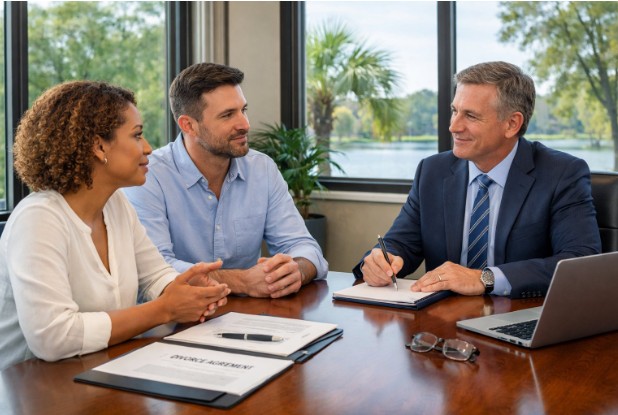
Divorce mediation can replace a contested court fight with a structured settlement process for many Northeast Florida couples.
Divorce mediation is a guided negotiation where two spouses meet with a neutral divorce mediator to resolve property division, parenting arrangements, and financial support without turning every issue into a courtroom dispute.
A neutral divorce mediator facilitates communication and keeps negotiations productive, so the spouses can make decisions and control the outcome.
Divorce mediation in Florida is a dispute-resolution process in which spouses negotiate settlement terms in a private setting rather than litigating each issue in court. The mediation agenda typically covers equitable distribution of assets and debts, time-sharing and parenting-plan terms, and support terms such as child support and alimony.
[cta_btn]
A Florida divorce mediator does not issue rulings and does not “pick a winner.” A Florida divorce mediator manages the process, clarifies options, and documents agreements, so each spouse can reach informed decisions without escalating conflict.
This step-by-step guide explains the full mediation journey—from the first intake call through drafting and finalizing the settlement terms—so Northeast Florida couples can prepare efficiently and negotiate with clarity.
Key Takeaways
- Divorce mediation lets you and your spouse work with a neutral professional to reach agreements without going to court.
- The process involves gathering financial information, attending negotiation sessions, and putting your agreements in writing.
- Mediation typically costs less and takes less time than traditional divorce litigation in Florida.
Divorce Mediation On The First Coast, Explained Simply

Divorce mediation is a structured negotiation process where a neutral mediator helps spouses reach practical agreements without taking sides or making decisions for them.
For Northeast Florida couples, mediation is commonly used to resolve parenting schedules, financial support terms, and property/debt decisions in a more efficient, respectful way than prolonged conflict.
How It Works
During the divorce mediation process, you meet with your mediator in private. The mediator doesn’t take sides or tell you what to do—they just keep the conversation on track and help you both brainstorm solutions.
Court-Ordered vs. Voluntary
Sometimes you pick mediation yourself, and sometimes a judge sends you there. Court-ordered mediation happens when the judge wants you to try working things out before a trial. Either way, the steps are pretty much the same.
Key Benefits for First Coast Couples
- Costs less than going to court
- Takes less time than a trial
- Keeps your information private
- Reduces stress and conflict
- Let’s you create custom solutions
Florida divorce mediation often leads to agreements that both people can live with. The sessions stay confidential, so what you discuss doesn’t go public.
When you reach an agreement, your mediator helps you put it in writing so your attorney can file it with the court.
PeaceMaker Mediation Group helps First Coast couples resolve parenting, support, and property decisions through calm mediation plus document preparation. Schedule your free 15-minute consultation now.
[callus_btn]
Step 1 — Start With An Intake Call And Confirm Mediation Fit

The first step in mediation is an intake form and a consultation. You’ll talk with a mediator about your situation and see if mediation actually fits your needs.
What Happens During the Intake Call
You’ll share basic info about yourself, your spouse, and your marriage. The mediator will ask what you need to sort out—property, custody, support, that kind of thing.
This is when you mention if your case is already in court. You might need to share details about any agreements or court orders you already have.
Confirming Mediation Is the Right Choice
Not every divorce fits mediation. The mediator checks if both of you are willing to negotiate honestly and show up in good faith.
Mediation works best when both sides can communicate respectfully and genuinely want to find solutions together. If your spouse is hiding assets or flat-out refusing to cooperate, you might have to go to trial instead.
Step 2 — Gather The Right Information Before You Negotiate
Before your mediation session starts, you’ll need to collect financial documents. It’s not the most thrilling part, but it helps you make smart decisions about property and support.
Start with tax returns from the past three years. You’ll also want recent pay stubs, bank statements, and retirement account statements.
Make copies of records about your assets and debts—mortgage statements, credit card bills, and loan documents. Grab vehicle titles, property deeds, and investment account statements, too.
Bringing the right documents helps everyone see the full financial picture.
Key documents to bring:
- Recent tax returns (3 years)
- Pay stubs and income records
- Bank and investment statements
- Retirement account info
- Property deeds and mortgage statements
- Vehicle titles and loan documents
- Credit card statements
- Business financial records (if you own a business)
Get these papers organized before you show up. A folder or binder with everything in one spot makes life easier.
If you have kids, gather info about childcare costs, health insurance, and school expenses. Don’t forget to note any special needs or medical costs.
Jot down which items matter most to you or any concerns about dividing property. Bring your questions to mediation, too. Being prepared reduces stress and saves time during negotiations.
Step 3 — Define The Decisions You Must Resolve
Before mediation really gets going, you need to figure out which issues you’ll need to resolve. This helps you and your spouse know what’s actually on the table.
Key Areas to Address:
- Property division – How you’ll split assets, debts, bank accounts, and real estate
- Child custody and time-sharing
- Parenting plan details, including who decides what
- Parenting schedules for holidays, weekends, and school breaks
- Child support payments and expenses
- Alimony or spousal support terms
Your mediator will help you make a list of all the decisions ahead. Some couples have it simple—few assets, no kids. Others have a laundry list: multiple properties, retirement accounts, and detailed parenting plans.
Bring documents for each area. For property, that means financial statements and property records. When planning time-sharing, consider kids’ school schedules and activities.
Mediation lets you tackle these issues at your own pace. Some decisions come quickly; others might take a few sessions. The point is to spot everything up front so nothing slips through the cracks.
Making a complete list keeps your final agreement thorough. It also helps you prepare mentally for what’s ahead.
Step 4 — Attend Mediation Session(s) And Negotiate Issue-By-Issue
During your mediation session, you and your spouse will go through each issue with the mediator’s help. Most people need more than one session to get through everything.
The mediator helps you take things one at a time. That way, you don’t get overwhelmed, and the talks stay on track. Common topics include:
- Dividing marital property and debts
- Parenting plans and time-sharing
- Child support calculations
- Spousal support (alimony)
- Splitting retirement accounts
Florida requires good-faith participation in mediation. You have to show up ready to negotiate and actually try to find reasonable solutions. Refusing to budge on everything won’t fly.
The mediator meets with both of you in joint sessions. Sometimes, they’ll talk to each of you privately in what’s called a caucus.
These private chats help the mediator understand your worries and discuss options you might not want to share with your spouse.
Preparing for your mediation session makes a big difference. Bring all the requested financial documents and your priorities for each issue.
You’re in charge of the outcome. The mediator can’t force you to agree to anything—they just help you explore solutions that fit your family’s situation.
Sessions usually last two to four hours. If things are complicated, you might need several meetings spread over a few weeks or months.
Step 5 — Put Agreements Into Clear, Written Terms
When you finally reach agreements during mediation, you’ve got to get it all in writing. This step turns your conversations into a formal document that’ll guide your divorce moving forward.
The mediator helps draft a mediation agreement listing every decision you made together. This document spells out everything, from property division to child custody arrangements.
What Gets Included:
- Division of assets and debts
- Child custody and parenting schedules
- Child support amounts
- Spousal support terms
- Property distribution details
- Any other agreed-upon terms
Your mediated settlement becomes part of your marital settlement agreement. The court has reviewed and approved this legal document.
It needs to be detailed and specific to avoid confusion later. If something’s vague, it could cause problems down the line.
Let your attorney review the written terms before you sign. They’ll check that the language protects your interests and that nothing important slips through the cracks.
Your attorney also makes sure the document meets Florida legal requirements. Don’t skip this step—it’s worth the peace of mind.
The divorce settlement should use clear language that both of you understand. Each point needs to spell out exactly who does what, when, and how.
Once you both approve the written agreement, file it with the court. The judge will review it and ensure it’s fair and in compliance with Florida law.
After approval, your mediation agreement becomes a court order. That’s when it’s truly official.
Ready to negotiate without court stress? Book a phone or Zoom consultation, and let PeaceMaker Mediation Group guide a structured mediation session. Contact us.
[callus_btn]
Step 6 — Optional: Consult An Attorney Independently (Mediator Stays Neutral)
Divorce mediation uses a neutral third party—the mediator—who can’t give legal advice to either spouse. Their job is to help you and your spouse talk things through and reach agreements, not to tell you what to do.
You have the right to consult with your own attorney at any point during mediation. Many couples in Northeast Florida hire independent lawyers to review agreements before signing. Honestly, it just gives you peace of mind that your rights are covered.
Your attorney can:
- Review proposed settlement terms
- Explain how Florida law applies to your situation
- Point out potential problems or unfair provisions
- Suggest changes that better protect your interests
- Answer legal questions the mediator can’t address
The mediator stays neutral, even if you bring an attorney into the process. They won’t take sides or favor either spouse.
Mediators facilitate communication and help couples negotiate, but they don’t make decisions for you.
Having separate legal counsel doesn’t mean mediation failed. Actually, getting independent legal advice often smooths things out. When you know your rights, you just make better decisions.
Some couples in First Coast, Florida, talk to attorneys before starting mediation. Others wait until midway through or just for the final review. It really depends on your comfort level and how complicated things are.
Step 7 — Finalize Next Steps Toward Filing And Closure
Once you reach a mediation agreement, your mediator creates a written document outlining all the terms you and your spouse agreed to. This becomes the foundation for your final divorce papers.
Your mediator can’t file paperwork for you. You or your attorney needs to take the mediation agreement and incorporate it into the official court documents for Florida’s divorce process.
Key actions to complete include:
- Review the mediation agreement carefully with your attorney
- File the agreement with the circuit court
- Submit any additional required forms
- Pay applicable court fees
- Schedule a final hearing if needed
Some courts approve your divorce without requiring you to show up if you both agree on all terms. Other judges want a brief final hearing to make sure everyone understands the agreement.
Once the judge signs your Final Judgment of Dissolution of Marriage, your divorce is official. You should get certified copies of this document for your records.
Important items to address after finalization:
- Update beneficiaries on insurance policies and retirement accounts
- Change names on titles and deeds as specified in the agreement
- Open separate bank accounts if you haven’t already
- Implement the parenting plan and time-sharing schedule
The timeline from finalizing mediation to receiving your final judgment varies by county. Most uncontested divorces in Florida take about 30 to 90 days after filing.
Confidentiality On The First Coast: What’s Protected In Mediation
Florida law gives you strong privacy protections for everything that happens during divorce mediation. These rules let couples talk openly about sensitive financial and family matters without worrying that their words will get used against them in court.
What “Mediation Communications” Means
Florida’s mediation confidentiality laws protect discussions and documents you share during sessions. So, anything you say during mediation can’t be used in court proceedings.
The law covers more than just what you say out loud. It also includes written proposals, financial documents you look at together, and even the mediator’s notes. Your body language and emotional reactions? Those are protected, too.
Your mediator can’t be called as a witness about what happened in your sessions. The same goes for any professionals who help out, like financial advisors or child specialists.
This protection extends to everyone in the room, including your spouse and any attorneys present. It’s a wide net, and that’s honestly a relief for most people.
Why Confidentiality Matters For Settlement Discussions
Confidentiality protections help both spouses speak openly without worrying that their words will surface in court later. You can explore settlement options or make compromise offers without creating evidence that could bite you if mediation falls apart.
This privacy encourages honest conversations about tough topics. You can talk about your true financial situation, parenting concerns, or relationship issues without feeling like you need to strategize every word.
The law also protects you from having early settlement offers held against you. If you suggest giving up certain assets during mediation, that offer stays private if you don’t reach a final agreement.
It lets you negotiate in good faith without worrying about permanent consequences.
Cost And Time Expectations For First Coast Divorce Mediation
Divorce mediation in Florida usually costs between $3,000 and $8,000 for both spouses combined. That’s way less than a traditional divorce, which can run $15,000 to $40,000 per person.
Mediation costs in First Coast, Florida, break down like this:
- Mediator’s hourly rate (usually $150 to $400 per hour)
- Court filing fees
- Document preparation costs
- Attorney review fees if you decide to get legal counsel
The time your mediation takes really depends on how complicated your situation is. If you’ve got a few assets and no kids, you might need only 2-4 hours of mediation.
Cases involving children, property division, or business interests can take 6-10 hours, spread across several sessions. There’s no one-size-fits-all answer here.
Most First Coast couples get through mediation in 2-3 months from start to finish. That’s a lot faster than contested divorces, which can drag on for a year or more.
Your mediation expenses include the mediator’s time, paperwork, and any extra services for more complicated cases. Many mediators want a deposit upfront before your first session.
You can cut costs by preparing your financial documents in advance and staying focused during sessions.
Coming in with realistic expectations and a willingness to compromise also helps keep things moving (and cheaper).
Some mediators offer payment plans if you can’t pay the full amount up front. It never hurts to ask about this during your initial consultation.
How PeaceMaker Mediation Group Helps First Coast Couples Reach an Agreement
PeaceMaker Mediation Group provides divorce mediation services to families in Northeast Florida who want settlement-focused negotiation rather than conflict-driven litigation.
PeaceMaker Mediation Group positions divorce mediation as a collaborative process that helps two spouses reach workable agreements on parenting arrangements, property division, and financial support.
Key ways PeaceMaker Mediation Group supports divorcing couples in Northeast Florida:
- Court communication management: PeaceMaker Mediation Group manages court-related communication and procedural touchpoints throughout the mediation workflow, so spouses can focus on negotiation in a calm, private office setting.
- Custom parenting plan development: PeaceMaker Mediation Group helps parents build a written parenting plan tailored to the child’s routine, school schedule, transportation realities, and each parent’s availability.
- Parenting schedule trial periods: PeaceMaker Mediation Group supports trial periods for proposed time-sharing schedules, so parents can test real-world feasibility before finalizing long-term terms.
- Neutral, structured facilitation: PeaceMaker Mediation Group mediators guide structured conversations about parenting, support, and asset-and-debt decisions while remaining neutral and non-adversarial.
PeaceMaker Mediation Group structures mediation around respect, efficiency, and clear decision-making.
Spouses use guided negotiation to design settlement terms that align with household realities, thereby retaining control over outcomes rather than delegating decisions to a judge.
Structured mediation sessions keep discussions on topic, reduce escalation, and convert verbal agreements into clear written terms that both spouses can follow.
If you want an uncontested path with clear paperwork and calmer conversations, request a free 15-minute phone or Zoom consult with PeaceMaker Mediation Group.
[contactus]
Frequently Asked Questions
What is divorce mediation in First Coast, Florida?
Divorce mediation in First Coast, Florida, is a private, structured negotiation in which two spouses work with a neutral mediator to reach agreements on parenting, support, and property. The mediator facilitates productive discussion, enabling spouses to reach outcomes without litigating every issue.
Is divorce mediation required in Jacksonville or Northeast Florida?
Many Florida divorce courts strongly encourage—and sometimes require—mediation before a judge hears contested issues. Requirements vary by county and case type, but mediation is commonly used to attempt settlement before trial or contested hearings.
What issues can divorce mediation cover?
Divorce mediation can cover parenting plans and time-sharing, child support, alimony, and equitable distribution of assets and debts. Couples use mediation to negotiate practical terms and reduce disputes, rather than asking a judge to decide each issue.
How long does divorce mediation take in Florida?
Florida divorce mediation timelines depend on the complexity, the availability of financial information, and the level of cooperation. Some couples resolve major terms in one session, while others need multiple sessions to finalize parenting schedules, support terms, and property/debt division.
How much does divorce mediation cost in Northeast Florida?
Divorce mediation costs vary by the mediator’s rate, session length, and case complexity. Costs often increase when financial assets are complex or parenting issues require multiple sessions. Many couples pursue mediation to reduce total litigation-related expenses.
Is divorce mediation confidential in Florida?
Florida law generally makes mediation communications confidential, with defined exceptions. Florida Courts also note that a signed mediated settlement agreement is not automatically confidential unless the parties agree and the law permits confidentiality.
Do I need a lawyer for divorce mediation in Florida?
Divorce mediation does not require attorneys for every case, but many spouses choose independent legal advice for complex assets, retirement accounts, or long-term support. A neutral mediator facilitates negotiation and does not represent either spouse.