
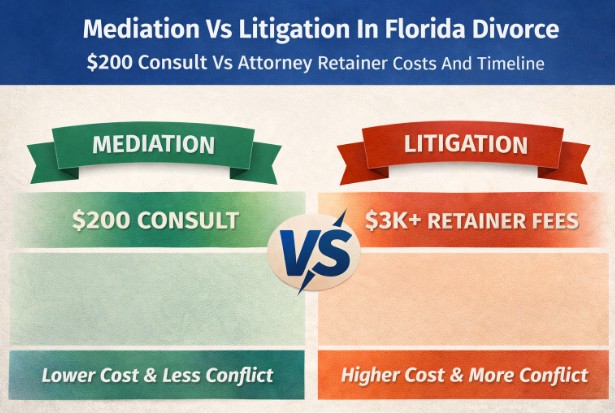
Florida divorce mediation resolves parenting, support, and property terms through a signed Marital Settlement Agreement.
Florida divorce litigation resolves the same issues through attorney-led court procedure and judicial orders.
Most spouses choose mediation to control cost, protect privacy, and reduce timeline uncertainty. A $200 consult, plus a package choice under flat-fee pricing, sets the fastest decision path.
[cta_btn]
Key Takeaways
- Florida divorce mediation resolves terms through a signed Marital Settlement Agreement, while Florida divorce litigation resolves terms through attorney-led discovery, hearings, and judicial orders.
- Many Florida clerk schedules list a dissolution filing fee around $409, but total divorce cost changes most with attorney hours, discovery scope, and hearing volume.
- Florida contested divorces commonly take 6 months to 2 years, while uncontested paths move faster when spouses cooperate, and documents stay consistent.
- Private mediation typically costs the couple in the low thousands, while contested litigation can reach tens of thousands per spouse as discovery and hearings expand.
Mediation Vs Litigation In One Sentence
Divorce mediation is a process led by a neutral mediator to settle. Divorce litigation is a dispute process led by attorneys and driven by pleadings, discovery, hearings, and trial preparation.
What Mediation Is In A Florida Divorce
Florida divorce mediation is a structured negotiation in which spouses resolve time-sharing, child support, alimony, property division, and debt allocation without converting each disagreement into a motion or hearing.
Mediation produces a written Marital Settlement Agreement that supports entry of a Final Judgment when the filing packet is complete and consistent.
Many spouses compare mediation benefits to the courtroom process, asking why choose mediation, because the decision often turns on cost predictability and control.
Florida dissolution paperwork relies on Florida Supreme Court-approved forms listed on the Florida family law forms, which serve as the anchor for the document structure regardless of the settlement path.
What Litigation Is In A Florida Divorce
Florida divorce litigation is an attorney-led process where disputed issues move through pleadings, mandatory disclosure, discovery, motions, hearings, and trial preparation.
Litigation costs rise when spouses dispute time-sharing schedules, income, asset values, or support structures.
Litigation timelines expand when hearings stack up on court calendars and discovery disputes delay settlement.
A litigation baseline is easier to understand when spouses read contested divorce because the contested procedure explains why attorney time multiplies when disagreement persists.
[callus_btn]
The Real Cost Drivers In Florida Divorce
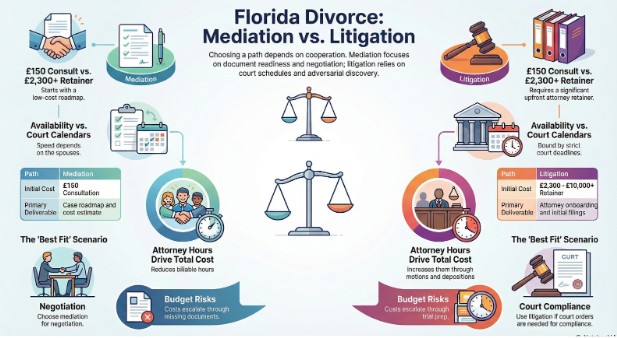
Mediation and litigation both require documents. Litigation adds paid conflict through attorney hours, discovery events, hearings, and expert work.
Litigation Cost Drivers
- Attorney hours for strategy calls, emails, drafting, and court preparation
- Discovery scope, including subpoenas, depositions, and document review
- Motion practice and hearings that reset timelines
- Expert work, including appraisals, business valuation, and forensic accounting
- Conflict loops that reopen terms after partial agreement
Mediation Cost Drivers
- Issue count, especially parenting schedules and support terms
- Financial documentation quality at the start of negotiation
- Revision cycles when spouses change terms repeatedly
- Asset complexity, including retirement accounts and real property transfers
A filing plan reduces cost on both paths by preventing document rework and clerk rejection.
Court-compliant drafting and assembly begin with the preparation of Florida divorce documents.
Cost Comparison Table. $200 Consult Vs Attorney Retainer Economics
This table compares the cost structure, not a promise of outcome. Cost structure predicts where budgets break.
| Cost Item | Mediation Path | Litigation Path |
| First Step | $200 consult with Peacemaker Mediation Group | An attorney retainer commonly starts in the thousands before substantive work begins |
| Primary Billing Model | Mediation hours plus drafting scope | Hourly attorney billing plus costs funded by retainer |
| Primary Overrun Trigger | Revisions caused by unclear terms or missing documents | Discovery disputes, hearings, continuances, and adversarial escalation |
| Best Fit | Spouses want control and a negotiated agreement | Spouses need court orders because a settlement is not reachable |
Typical Cost Ranges Planning Numbers That Match Real Decisions
The cost of a Florida divorce depends more on the intensity of the conflict and the quality of the documentation than on filing fees. A spouse controls costs by controlling disagreement and document readiness.
| Scenario | Typical Cost Pattern | What Usually Changes The Total |
| Mediation With Organized Documents | Low thousands for the couple is common when spouses settle quickly | Missing documents, repeated edits, and an unclear parenting schedule |
| Attorney Filing After Full Agreement | Low thousands are common when terms are already settled | Support disputes, debt disputes, and parenting changes |
| Contested Litigation | Tens of thousands per spouse becomes common when discovery and hearings expand | Depositions, experts, emergency motions, trial prep |
A cost-first decision path usually starts with the Florida mediation cost, as the cost drivers determine the appropriate service level before drafting begins.
Filing Fees Table. The Court Costs Every Divorce Pays
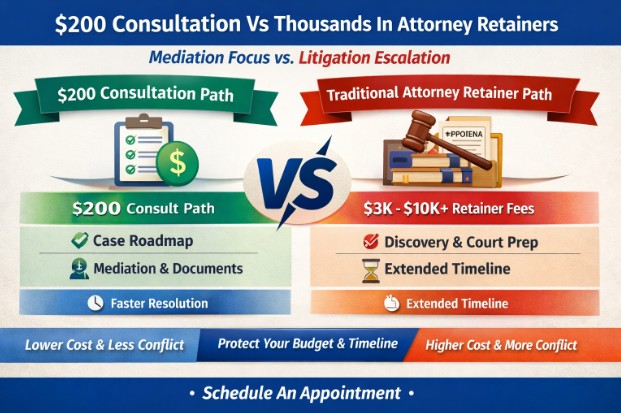
Most Florida divorces include a clerk’s filing fee. Many Florida clerk resources list dissolution filing fees around $409, with additional service or summons fees depending on case requirements.
Florida clerk instructions vary by county and case type. A county baseline example appears on the Miami-Dade simplified divorce page.
| Filing Item | Typical Baseline | What Can Add Cost |
| Dissolution Filing Fee | About $409 in many counties | County variations, add-on fees, payment rules |
| Service Of Process | Varies | Sheriff or private process server, multiple attempts |
| Certified Copies | Varies | Lenders, schools, and agencies require certified proof |
A filing moves faster when the packet meets court form instructions on the first submission, reducing rejection events and rework.
Peacemaker Mediation Group clarifies mediation vs litigation costs and timelines fast. Start with a free 15-minute phone or Zoom consult. Schedule an appointment.
[callus_btn]
Mediation Timeline Vs Litigation Timeline in Florida
Timeline matters because it drives costs and stress. Florida contested cases often extend when discovery, hearings, and court calendars create waiting periods.
| Timeline Marker | Mediation Path | Litigation Path |
| Early Momentum | Starts when spouses agree to negotiate and exchange basics | Starts after filing, service, and response windows |
| Typical Resolution Range | Faster when spouses cooperate, and documents stay consistent | Often 6 months to 2 years in contested cases, longer in high conflict |
| Biggest Delay Trigger | Incomplete finances, unclear parenting terms, and revision loops | Discovery disputes, hearings, continuances, expert work, trial prep |
A settlement-to-filing workflow moves fastest when the settlement structure is clean in an uncontested divorce, as the uncontested structure reduces contradictions across documents.
When Mediation Saves The Most Money
Mediation produces the biggest savings when spouses can still make decisions together, even with tension. Mediation saves money by reducing attorney hours and minimizing motion practice.
Mediation usually works best when:
- Spouses disagree on details, not fundamentals
- Spouses exchange financial documents without concealment games
- Spouses want privacy and do not want public courtroom accusations
- Spouses want to keep parenting decisions out of repeated hearings
Parents who need a court-usable parenting structure can anchor language using a Florida parenting plan so parenting terms read like enforceable orders.
When Litigation Becomes Likely
Litigation becomes more likely when one spouse cannot negotiate in good faith or refuses baseline disclosure.
Litigation also becomes more likely when safety concerns require immediate court intervention.
Litigation becomes likely when:
- A spouse hides income, assets, or account access
- A spouse refuses a workable time-sharing schedule or uses children as leverage
- Domestic violence or safety threats require emergency protective orders
- A spouse refuses to sign the final settlement terms under any conditions
Florida parenting decisions and time-sharing orders follow the statutory framework set forth in Florida Statute 61.13, which explains why precise parenting terms matter in both settlement and litigation.
Court-Connected Mediation Vs Private Mediation
Court-connected mediation can settle disputes, but court-connected mediation often does not include agreement drafting, revisions, or filing coordination.
Private mediation more often includes structured term-building and document alignment that supports filing readiness.
A county-specific comparison belongs in St. Johns, court-connected vs. private mediation, because local procedure shapes the practical experience.
The Decision Filter. Choose The Lowest Friction Option That Still Works
This matrix turns emotions into a decision framework. A spouse can use this matrix to pick the lowest-friction option that still protects legal needs.
| Question | Mediation Fits | Litigation Fits |
| Can both spouses exchange documents without gamesmanship | Yes | No |
| Can both spouses agree on a parenting schedule framework | Yes | No |
| Does one spouse need emergency court protection | No | Yes |
| Do spouses want a predictable budget | Yes | No |
| Do spouses need a judge to force compliance | No | Yes |
Child support terms often trigger conflict when assumptions differ. Florida child support guidelines are set forth in Florida Statute 61.30, which establishes the variables that drive the final amount.
Practical Next Steps Based On Your Situation
A Florida divorce moves faster when spouses choose the correct sequence at the start. A cost plan requires verified financial inputs, including income records, monthly expenses, debts, and account statements.
A filing plan requires consistent names, dates, and definitions across all forms, plus compliance with signature and notarization requirements where required.
A settlement plan requires specific decisions on time-sharing logistics, support structure, and property division terms that can be enforced without interpretation.
Ready to reduce attorney fees and court delays. Get a clean settlement plus court-compliant paperwork with Peacemaker Mediation Group. Contact us.
[contactus]
Frequently Asked Questions
Is Mediation Cheaper Than Litigation In A Florida Divorce
Florida mediation usually costs less because mediation reduces attorney hours, discovery events, and hearing volume. Florida litigation often costs more because attorneys bill for pleadings, mandatory disclosure, discovery, motions, and trial preparation.
How Long Does Mediation Take Compared To Litigation In Florida
Florida mediation can resolve issues faster when both spouses cooperate and provide financial documents early. Florida litigation often takes longer because court calendars, discovery deadlines, and hearing scheduling control the pace.
Does Mediation Still Require Court Filing In Florida
In Florida, mediation results in a signed Marital Settlement Agreement, but divorce is finalized through filed documents. A Florida judge enters a Final Judgment only after the correct forms and supporting paperwork are filed and are legally sufficient.
What Issues Can Florida Divorce Mediation Cover
Florida divorce mediation can cover parenting plans, time-sharing schedules, child support assumptions, alimony structure, property division, and debt allocation. A complete settlement resolves every required issue before filing.
When Does Florida Divorce Litigation Become Necessary
Florida divorce litigation becomes more likely when a spouse refuses financial disclosure, refuses workable time-sharing terms, or needs immediate court protection for safety. A judge can issue orders when negotiation fails.
What Drives The Biggest Cost In Litigation
Attorney hours drive the highest cost in litigation. Discovery disputes, repeated hearings, expert valuations, and trial prep expand attorney time and increase total cost more than filing fees.
What Documents Matter Most In Mediation
The Marital Settlement Agreement, Parenting Plan, and financial disclosure documents drive accuracy. Clear definitions, consistent dates, and complete attachments reduce revisions and prevent filing delays.
Can Mediation Work If Communication Is High Conflict
Mediation can still work when the mediator enforces structure, sets an agenda, and uses separate caucuses when needed. Mediation becomes more difficult when a spouse refuses to provide basic disclosure or to sign the final terms.